
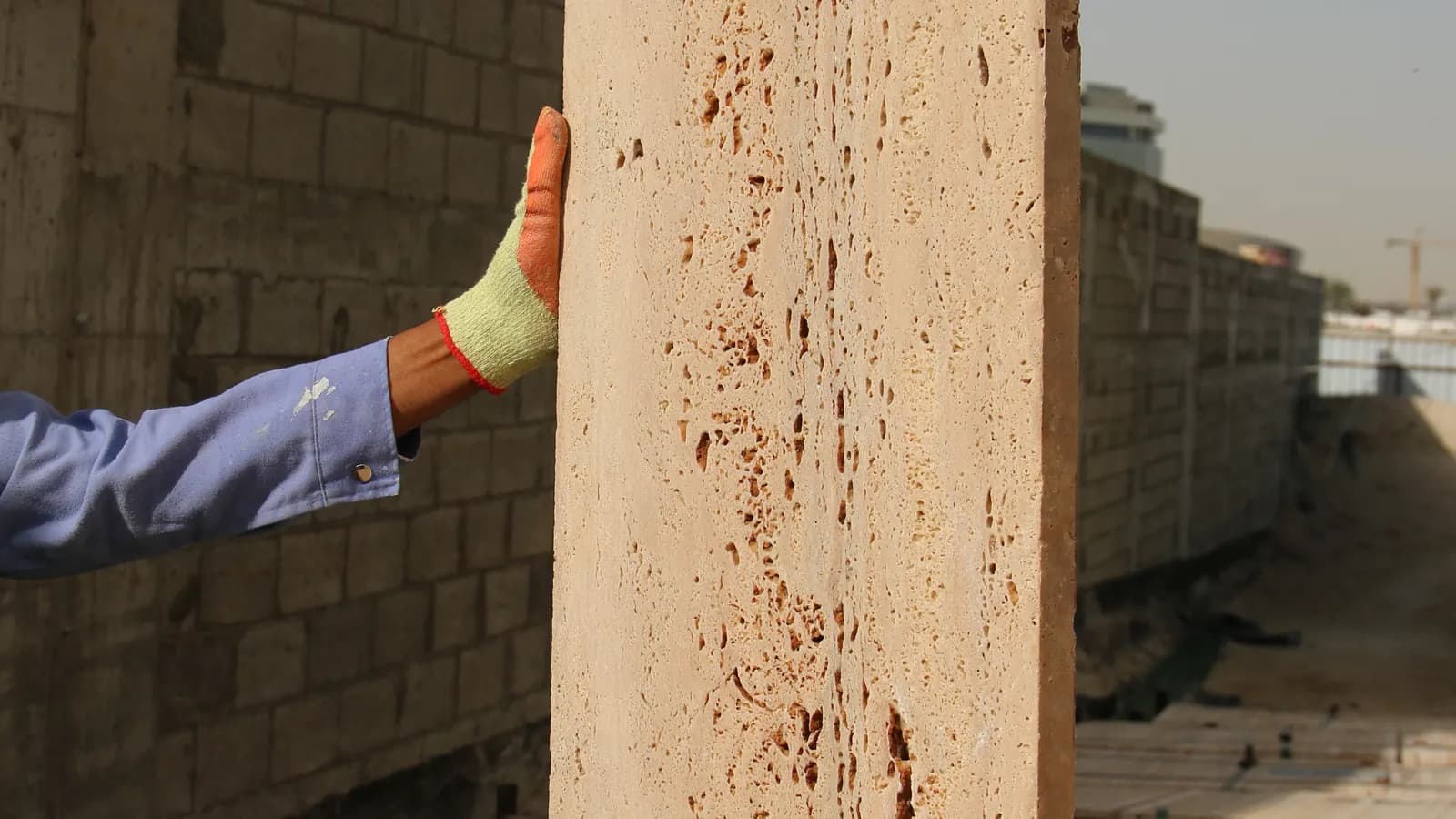
In Qatar's stone showrooms travertine is often sold as "travertine marble", and the two sit side by side in most collections, including ours. They are related, both are natural stone made of calcium carbonate, and both can be honed or polished. But they form in different ways, look and behave differently, and belong in different parts of a villa. As natural stone specialists who import Iranian travertine and supply marble from Oman, Turkey, Italy and Spain, this is how we explain the difference and where we specify each.
The short answer
- Marble is the formal stone. It is dense, takes a deep mirror polish, can be book-matched and carved, and is the material for the majlis, the entrance hall, the staircase and feature walls.
- Travertine is the warm, architectural stone. Its linear grain and soft ivory-to-walnut tones suit modern villa facades, courtyards, terraces, pool surrounds and calmer interiors, usually in a honed or brushed finish.
- Many of the best villas use both: travertine on the facade and outdoor spaces, marble inside where the house is received and admired.
Is travertine a type of marble?
No, although the trade often calls it one. Travertine is a form of limestone deposited by mineral springs: water rich in calcium carbonate rises to the surface, releases its minerals in layers, and gas and water leave small channels and pores through the stone. That is where travertine's linear banding and its characteristic holes come from.
Marble starts as limestone too, but it is transformed deep underground by heat and pressure until the stone recrystallises. That process closes the pores and creates the dense, crystalline body and the veining marble is known for. In short, travertine is a sedimentary stone with a layered, porous structure; marble is a metamorphic stone with a dense, crystalline one. In Arabic you will see both «حجر الترافرتين» and «رخام الترافرتين»; the stone is the same.
How they compare
| Travertine | Marble | |
|---|---|---|
| How it forms | Deposited in layers by mineral springs | Limestone recrystallised by heat and pressure |
| Structure | Porous, with natural holes; filled for most uses | Dense and crystalline |
| Look | Warm ivory, beige, walnut and silver; linear or cloudy grain | White, cream, grey, black and coloured; flowing veining |
| Polish | A soft sheen when polished; honed is more typical | A deep, mirror-like polish |
| Underfoot when wet | Honed or brushed finishes grip well | Polished marble is slippery when wet |
| Outdoors in Qatar | Excellent on facades and terraces when filled, sealed and properly fixed | Facades in dense, honed grades; not polished outdoors |
| Carving and book-matching | Limited by the pores | Carved, profiled and book-matched |
| Best known for | Modern facades, courtyards, pool surrounds, calm interiors | Majlis, entrances, staircases, feature walls |
| Care | pH-neutral cleaning, sealing, occasional re-filling of pores | pH-neutral cleaning, sealing, periodic polishing |
Our view: marble wherever the house is received and admired; travertine wherever the house meets the sun, the garden and the street.
Filled or unfilled: the decision that matters most
Straight from the quarry, a travertine slab is full of natural pores, from pinholes to openings a few centimetres long. Before most uses the pores are filled, with a colour-matched cementitious or resin filler, and the face is then honed or polished.
- Filled travertine gives a clean, continuous surface. It is what we use on Qatar facades and floors, because open pores collect fine dust, sand and water, and over a summer they can make a light facade look tired. Filled and sealed, the stone keeps its clean look for decades.
- Unfilled travertine keeps every hole open for a rustic, textured look. It has a place on feature walls and some garden settings, but it needs more cleaning in Qatar's dust and is not our choice for a main facade or an indoor floor.
Fill can wear over many years, especially on busy floors. Re-filling and re-honing restores the surface, in the same way a marble floor is re-polished.
Vein-cut or cross-cut: two stones from one block
How a travertine block is sliced changes its character completely.
- Vein-cut slabs are sliced so the layers show in profile, as long, straight, linear bands. This is the modern, architectural look used on most contemporary villa facades in Qatar, and it reads beautifully on large panels.
- Cross-cut slabs are sliced the other way, so the layers open into soft, cloud-like patterns. The result is warmer and more traditional, and suits floors, courtyards and interior walls.
Marble has a similar choice in how slabs are matched: book-matched slabs mirror each other across a wall, which is why marble is the stone for statement walls behind a majlis or a staircase.
What changes in Qatar's climate
Sun and heat. Light-coloured travertine reflects much of the sun, and its porous structure means it does not hold heat the way dense, dark stone does. That is why honed travertine is a traditional choice for terraces and pool surrounds in hot climates. Colour still matters more than the stone type: a dark stone in full afternoon sun will be hot whatever it is.
Grip. Around pools, on terraces and in bathrooms, honed, brushed or tumbled travertine gives better grip when wet than polished marble. Polished marble belongs indoors, in dry rooms.
Facade engineering. Both stones are heavy, and on a villa facade in Qatar both should be mechanically fixed with stainless steel anchors rather than relying on adhesive alone. The fixing, not the stone, decides how a facade performs over decades; see mechanical vs adhesive stone cladding.
Dust. Fine sand settles in every open pore and joint, which is why we fill and seal exterior travertine and specify a honed finish on busy marble entrances.
Where we specify each
| Space | Our usual specification |
|---|---|
| Modern villa facade | Vein-cut Iranian travertine, filled and sealed, honed or brushed |
| Classical or palace facade | Syrian or Omani stone, with carved detail |
| Majlis and reception hall | Natural marble, polished, large or book-matched slabs |
| Entrance hall and staircase | Marble, honed near the door and polished across the hall |
| Courtyard, terrace and pool surround | Honed or brushed travertine |
| Bathrooms | Honed travertine or marble, sealed |
| Feature walls | Book-matched marble for drama; vein-cut travertine for calm |
For a room-by-room guide to marble varieties, see the best marble for flooring in Qatar; for facades, see how to choose the natural stone for your villa facade.
Care and lifetime
Both stones are calcium carbonate, so both are etched by acids such as lemon, vinegar and many bathroom cleaners. Both should be cleaned with a pH-neutral cleaner and sealed. Marble floors are re-polished every few years; our guide to crystallization vs diamond polishing explains what that work involves. Travertine floors are re-honed and, where needed, re-filled. Neither is replaced: like all natural stone, both are restored.
Price
Travertine and marble overlap widely in price. Grade, cut, finish, slab size and thickness move the cost far more than the type of stone, and so does how much fabrication the design needs. We give a firm figure after a consultation, once the stone, the finish and the drawings are agreed.
How we deliver it
We import premium Iranian travertine directly and deliver it to site by the crate, as we did for a villa on Qetaifan Island in Lusail. Slabs are selected for colour and grain consistency, supplied filled for facades and floors, cut to size on our own CNC line, finished and sealed, then installed by our own crews with stainless steel mechanical fixing. The same team supplies and installs marble for interiors, so a villa's facade and its majlis can be specified, matched and delivered together. For villa facades in that area, see stone villa facades in Lusail.
Frequently asked questions
Is travertine stronger than marble?
Marble is generally denser and harder, which is why it takes a deeper polish and suits carved detail. Good-grade travertine, filled and correctly fixed, is fully suitable for villa facades, floors and terraces. The grade of the stone and the quality of the installation matter more than the type.
Is travertine good for Qatar's heat?
Yes. Light-coloured honed travertine stays comfortable outdoors and is a natural choice for terraces and pool surrounds. On facades it should be filled, sealed and mechanically fixed, as any natural stone cladding should be in the Gulf.
Should I choose filled or unfilled travertine?
Filled for facades, floors and anything that needs to stay clean in Qatar's dust. Unfilled only where you want a rustic texture and accept more cleaning.
Can travertine be polished like marble?
It can be polished, but the result is a softer sheen rather than marble's mirror finish, and the fill shows more under high gloss. Most travertine in Qatar villas is honed or brushed.
Is travertine more premium than marble?
They are premium in different ways. Marble is the stone of formal interiors and statement pieces; travertine gives modern facades and outdoor spaces their warm, architectural character. Choosing each for the right place is what makes a villa look considered.
Can travertine and marble be used together?
Yes, and it often works best: travertine on the facade, terraces and courtyard, and marble in the majlis, entrance and staircase. Their warm and cool tones can be matched during slab selection.
Planning a facade in travertine or an interior in marble? Auckland imports, fabricates and installs both across Qatar. Book a consultation, or visit our factory in Doha to see the slabs before anything is cut.