
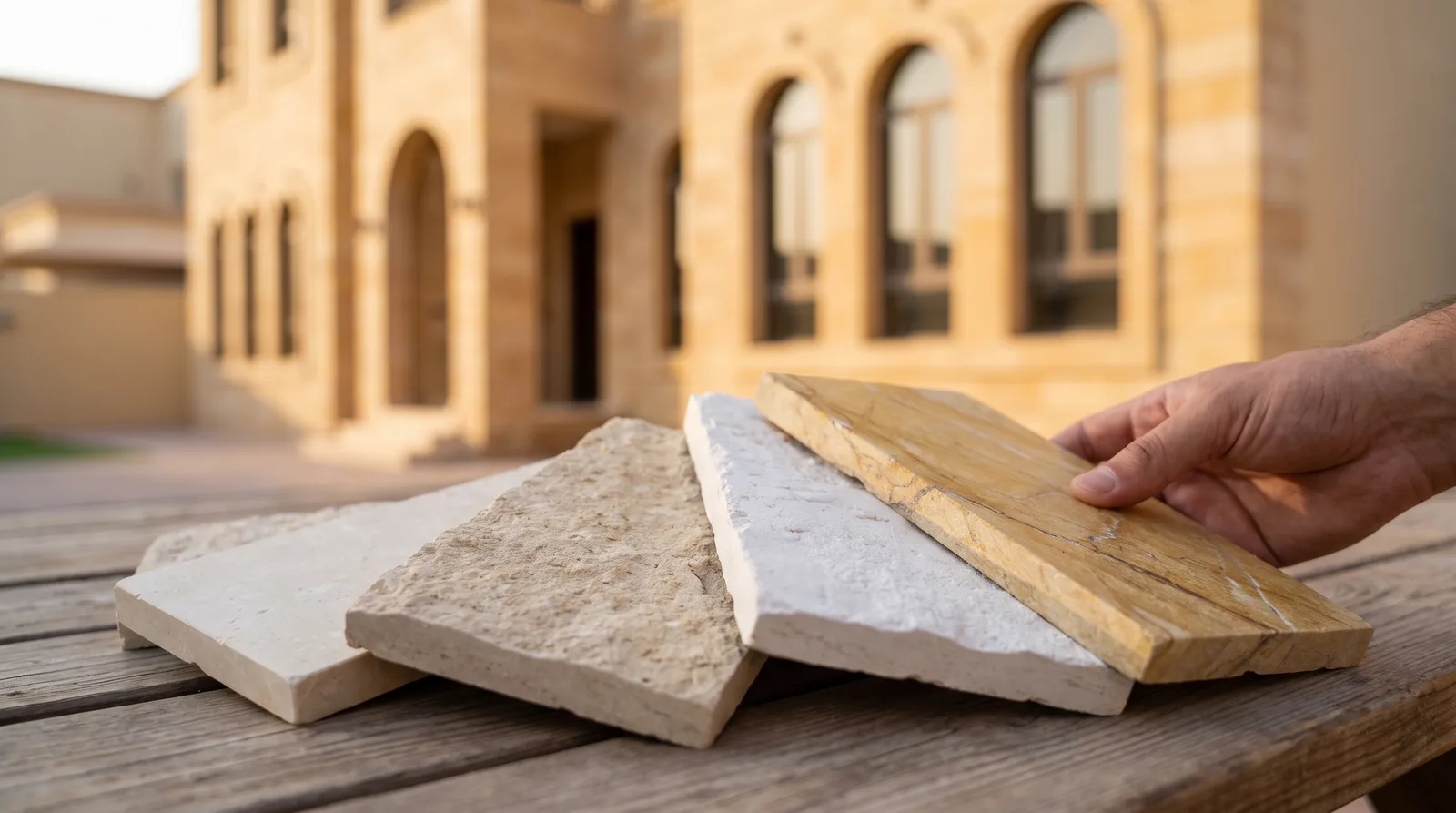
Choosing the right natural stone for a villa facade in Qatar comes down to four questions: how will it handle the heat, what look do you want, which finish suits the surface, and where on the villa will it be used? Get those right and the facade looks beautiful and lasts for decades. Here is a practical, no-jargon guide to the materials we supply and how to choose between them.
The quick answer
For most villa facades in Qatar, Syrian stone is the best all-round choice — dense, heat-resistant and clean-looking. Choose Omani stone for a brighter, grander facade or carved columns, travertine for a warm modern look, limestone for understated boundary and garden walls, and Turkish or Portuguese stone when you want a distinctive premium colour. Reserve marble for luxurious interiors, not exposed facades. The table below compares them at a glance.
Natural stone comparison for Qatar facades
| Stone | Best for | Look | Relative cost | Facade in Qatar's heat? |
|---|---|---|---|---|
| Syrian stone | Main villa & commercial facades | Warm cream to golden, clean | QAR (mid) | Excellent — the default choice |
| Omani stone | Bright facades, carved columns, features | Bright ivory-white | QAR (mid-high) | Excellent (dense grades) |
| Travertine | Modern facades, cladding, floors | Warm ivory to walnut, linear grain | QAR (mid-high) | Good — when filled & sealed |
| Turkish stone | Distinctive premium facades | Wide colour & vein variety | QAR (high) | Very good |
| Portuguese stone | Landmark, high-end facades | Premium European limestone/marble | QAR (highest) | Very good |
| Limestone | Boundary walls, garden features, secondary elevations | Warm, natural, matte | QAR (low) | Fair — keep to sheltered/lower walls |
| Marble | Interiors: majlis, stairs, reception | Luxurious veining, polished | Varies | Interior only, not exposed facades |
Start with the climate
In Qatar, climate performance comes first. Doha's summers are brutal and coastal humidity is constant, so the two properties that matter most are low water absorption and high density — they are what stop a facade from cracking, staining and fading. Dense stones perform best on exposed, sun-facing elevations; softer, more porous stones are better kept to sheltered or lower walls.
Syrian stone — the all-rounder
Syrian stone is the default choice for primary villa and commercial facades in Qatar, and the most requested material we install. It offers warm cream-to-golden tones, very high density, low water absorption and a clean, modern look that suits the popular white-stone facade style. If you want one stone that handles almost any elevation, this is it.
Omani marble — luxury interiors and features
Omani marble is the material for moments that need to feel special: majlis floors, feature walls, staircases and entrance halls. Regionally sourced from Oman, it delivers dramatic veining and warm ivory tones with a lower carbon footprint and price than European marble. It is more of an interior and feature stone than a full-facade cladding.
Limestone — an understated natural look
Limestone brings a genuine natural-stone aesthetic to boundary walls, garden features and large, simpler areas where maximum density is less critical. It will not match Syrian stone on a fully exposed facade, but on the right surfaces it keeps the whole villa authentically natural stone.
Turkish and Portuguese stone — premium variety
Turkish and Portuguese stone are the premium, European-grade options for when a project needs a very specific colour, vein or finish that sets it apart. They are ideal for signature facades and high-end developments where the design calls for something distinctive.
Travertine — a warm, modern facade
Travertine is the pick for a contemporary villa that wants a warm, natural character rather than bright white. Its ivory-to-walnut tones and distinctive linear grain give a soft, understated-expensive look. Because travertine is naturally porous, for Qatar's exterior it must be filled, sealed and mechanically fixed — done that way, it makes a beautiful modern facade, cladding or floor.
Choosing the right finish
Finish changes both the look and the performance. Honed gives a smooth, matte, contemporary surface; polished adds shine and is best kept to interiors; bush-hammered and split-face add texture and grip, which makes them ideal for non-slip outdoor paving and characterful facades. Panel thickness, usually 2cm to 4cm, affects strength, look and price.
Cost and next steps
As a working guide, supplied-and-installed natural stone in Qatar runs roughly QAR 150 to 350 per m2, depending on the stone, finish and detailing. The expert approach is to specify each elevation for its role: the finest stone and carving on the entrance and main facade, a complementary stone on secondary walls. Use our facade cost calculator for an instant per-square-metre estimate, then book a site consultation with Auckland to confirm the right specification.
Frequently asked questions
What is the best natural stone for a facade in Qatar?
For most villa facades, Syrian stone is the best all-round choice thanks to its high density, low water absorption and clean look, with Omani marble reserved for luxury interiors and features.
How much does natural stone cladding cost in Qatar?
As a guide, supplied and installed it runs roughly QAR 150 to 350 per m2 depending on the stone, finish and detailing — use our calculator for an instant estimate.
Which finish is best for an outdoor facade?
Honed and bush-hammered finishes work well outdoors; bush-hammered and split-face also add grip, while polished surfaces are usually kept for interiors.
Syrian stone or Omani stone for a villa facade?
Both are excellent dense facade stones. Choose Syrian stone for a warm cream-to-golden main facade — it is the all-round default in Qatar. Choose Omani stone for a brighter, whiter facade or when you want carved columns and features in the same material. Many Doha villas use Syrian stone across the main elevation and Omani stone on the entrance and columns.
What is the best stone for a modern villa facade in Qatar?
For a bright modern facade, white Syrian stone or Omani stone in large honed panels give the clean, monolithic look. For a warmer contemporary character, vein-cut travertine is the choice. All should be mechanically fixed for Qatar's heat.
Ready to choose? Compare options with our facade cost calculator, or book a site consultation and let Auckland recommend the right stone for each elevation.