
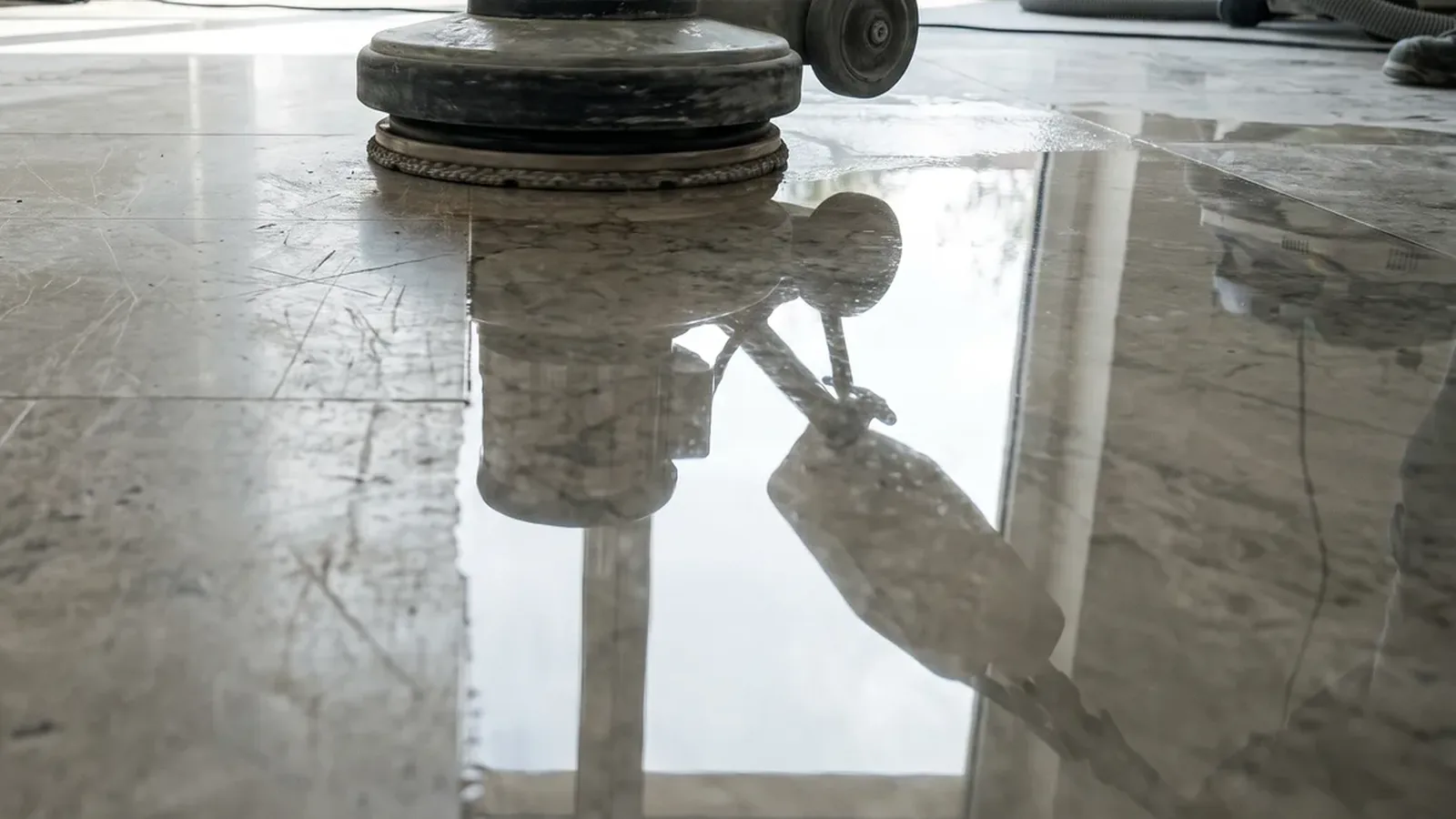
In Qatar almost every floor-care company offers "polishing and crystallization", often in the same breath. On the day the work is done, a crystallized floor and a diamond-polished floor can look equally glossy. They are not the same treatment, they do not fix the same problems, and choosing the wrong one can leave a marble floor looking worse a year later. As natural stone specialists who have supplied, installed and restored more than 211,000 m² of stone in Qatar since 2011, this is how we decide which one a floor actually needs.
The short answer
- Diamond grinding and polishing restores the floor. It flattens uneven tile edges, removes scratches, etching and dull patches, and brings the shine up from the stone itself. It can be repeated for the life of the floor.
- Crystallization is a surface treatment, not a repair. It chemically hardens and glosses the top layer of calcite-based marble. It suits a floor that is already flat and sound, in heavy traffic. It does nothing for scratches or lippage, and it is the wrong choice for granite, for many coloured marbles and for wet or outdoor areas.
- Our order is always the same: restore the floor first, then decide whether it should be sealed, left honed, or crystallized.
What each treatment actually does
Diamond grinding and polishing
This is a mechanical process. Resin-bonded diamond pads are run over the floor in stages, starting coarse to grind away scratches, etching and the edges of uneven tiles, then working through finer and finer grits until the surface reaches the finish you want, from a soft honed matte to a high gloss. The shine is the stone's own crystal structure, polished smooth, so it looks deep rather than coated. A penetrating sealer then protects the marble against staining without closing its surface.
Because it removes a thin layer of stone, diamond polishing fixes the cause of a dull floor rather than hiding it. A solid marble floor can be restored this way many times over its life.
Crystallization
Crystallization (also called vitrification, and in Arabic كريستال or كرستلة) is a chemical process. A fluorosilicate compound is sprayed onto the floor and worked in under a heavy machine fitted with a steel-wool pad. The heat and friction drive a reaction with the calcium carbonate in the marble, forming a harder, glossier and more stain-resistant layer at the surface.
Two things follow from that chemistry. First, it only works on stone that contains calcium carbonate: most marbles and limestones. Second, it permanently changes the surface. A crystallized layer cannot be washed off; it can only be ground away with diamond tooling. The stone industry itself is divided on the process: some restorers rely on it for busy commercial floors, others refuse to use it on fine marble.
Side-by-side comparison
| Diamond grinding and polishing | Crystallization | |
|---|---|---|
| What it is | Mechanical: removes a thin layer of stone with diamond abrasives | Chemical: a fluorosilicate reacts with the marble's surface |
| Removes scratches and etching | Yes | No |
| Flattens lippage (uneven tile edges) | Yes | No, and it makes the edges shine |
| Where the shine comes from | The stone itself, polished | A hardened surface layer |
| Stones it works on | Marble, limestone, granite, travertine | Calcite-based marble and limestone only |
| Reversible | Yes, it can be repeated | No; removed only by grinding |
| Best for | Restoring any worn or damaged floor | Extra surface hardness on a flat, sound floor in heavy traffic |
| Wet and outdoor areas | Honed finish recommended | Not recommended |
Our view: diamond polishing is the treatment; crystallization is an optional finish on top of it, for the right stone in the right room.
Why the first-day shine can mislead
Crystallization is popular because it is fast and the result is impressive on the day. The problems show later.
- It polishes the defects, not just the floor. If tiles are uneven, a high-gloss surface makes every raised edge catch the light. Scratches and acid etching stay where they were, now under a shinier layer.
- Layers build up. A floor that is re-crystallized every few months for years carries a thick treated layer. It can start to look glassy or plastic, go cloudy, or pick up a yellowish cast, and at that point the only fix is to grind it all off.
- It closes the surface. Conservation research on fluorosilicate treatments found that they can block the stone's pores. Indoors on a dry upper floor that matters little; on ground-floor slabs, in bathrooms or anywhere moisture rises through the stone, a sealed-shut surface is a risk.
- Not every stone reacts the same way. Granite, quartzite and porcelain contain little or no calcium carbonate, so "crystallizing" them achieves nothing beyond a temporary coating. Dolomitic marbles such as Thassos react less predictably, and some coloured marbles can haze or burn under the steel-wool pad. That is why we test a small area first.
What changes in Qatar
Fine sand acts like sandpaper. Qatar's dust is carried into every house and building, and on a high-gloss floor it wears the shine fastest at entrances. This is the one situation where crystallization earns its place: its harder surface resists scuffing for longer in a busy lobby or entrance hall, provided the floor was properly flattened first.
Wet rooms, ground floors and condensation. Bathrooms, kitchens and ground-floor slabs where moisture can rise are better served by a breathable, sealed finish than by a closed, crystallized one.
Outdoors, never. Facade stone, terraces and pool surrounds should be honed or flamed and left breathable. A crystallized high-gloss surface outside is slippery when wet and works against the stone in the heat. For the outside of a villa, see how to maintain a natural stone facade in Qatar.
Which floor needs which treatment
| Your floor | What we recommend |
|---|---|
| Dull, but flat and unscratched | Polishing, then seal |
| Scratched, etched or with lippage | Grinding and full restoration, then seal |
| Busy entrance hall in calcite marble, already restored | Restoration, then crystallization if you want maximum surface hardness |
| Previously crystallized, now cloudy or yellowed | Grind the treated layer off, restore, then seal |
| Granite, quartzite or porcelain | Diamond polishing only; crystallization will not react |
| Majlis or reception hall you want to keep for decades | Diamond polish to a deep gloss and seal |
How we decide on your floor
- Inspect and identify. We confirm the stone (calcite marble, dolomitic marble, limestone or granite) and check for lippage, hollow-sounding tiles, etching, stains and any previous coatings or crystallization.
- Test a small area. We test the stone's response before committing the whole floor, and recommend the lightest process that solves the problem.
- Restore. Diamond tooling grinds the floor flat where needed, holes and chips are filled, and the surface is polished through the grits to your chosen finish.
- Finish. Most villa floors are sealed. Where a calcite marble floor takes heavy daily traffic and you want the hardest possible gloss, crystallization is applied as the final step, on a floor that is already flat and sound.
- Aftercare. We advise a pH-neutral cleaning routine and a realistic polishing cycle for each room.
The same team that installs Auckland's marble floors restores them, so the advice is based on how the stone was laid as well as how it looks today. See our marble polishing and restoration service for the full process.
What it costs
As a 2026 guide, standard grinding and polishing of a marble floor in reasonable condition costs about QAR 25–60 per m² in Qatar, and heavier restoration for deep scratches, stains or uneven tiles about QAR 60–120 per m². Crystallization is quoted on site, because it depends on the stone and on whether the floor needs restoring first. The marble polishing cost guide explains what moves the price.
The honest comparison is not the price of one visit. A floor that has been properly restored and sealed needs only periodic polishing; a floor that is only ever crystallized has to be re-treated regularly and eventually ground back to the stone anyway.
Frequently asked questions
Is crystallization bad for marble?
Not in itself, on the right stone. On a flat, sound calcite marble floor in heavy traffic it adds surface hardness and gloss. It becomes a problem when it is used instead of restoration, applied over and over until it builds up, used on stone it does not suit, or used in wet and outdoor areas.
Can crystallization remove scratches?
No. It hardens and glosses the surface but does not remove material, so scratches, acid etching and uneven tile edges remain. Those need diamond grinding and polishing.
Can granite or porcelain be crystallized?
No. Crystallization relies on a reaction with calcium carbonate, which granite, quartzite and porcelain contain little or none of. They are polished with diamonds instead. Our marble vs granite guide explains how the two stones differ.
My floor was crystallized before and now looks cloudy. Can it be fixed?
Yes. The treated layer is ground off with diamond tooling, the marble is restored and polished, and the floor is sealed. In most cases it comes back to a clear, deep shine.
How long does crystallization last?
It depends on traffic. In a busy commercial lobby it is renewed on a regular maintenance cycle; in a quiet home it lasts much longer. Either way it wears with use and has to be renewed, unlike a properly restored floor, which only needs periodic polishing.
What is best for a majlis floor?
Diamond polishing to a deep gloss, then a penetrating sealer. A majlis is where a marble floor is most admired, and a polished finish from the stone itself is what gives natural marble its depth. Our guide to the best marble for flooring in Qatar covers the choice of stone room by room.
Not sure whether your floor needs polishing, restoration or crystallization? Auckland inspects and tests marble floors across Doha and Qatar and recommends the lightest process that solves the problem. Book a site consultation, and we will tell you what your floor needs before any work begins.