
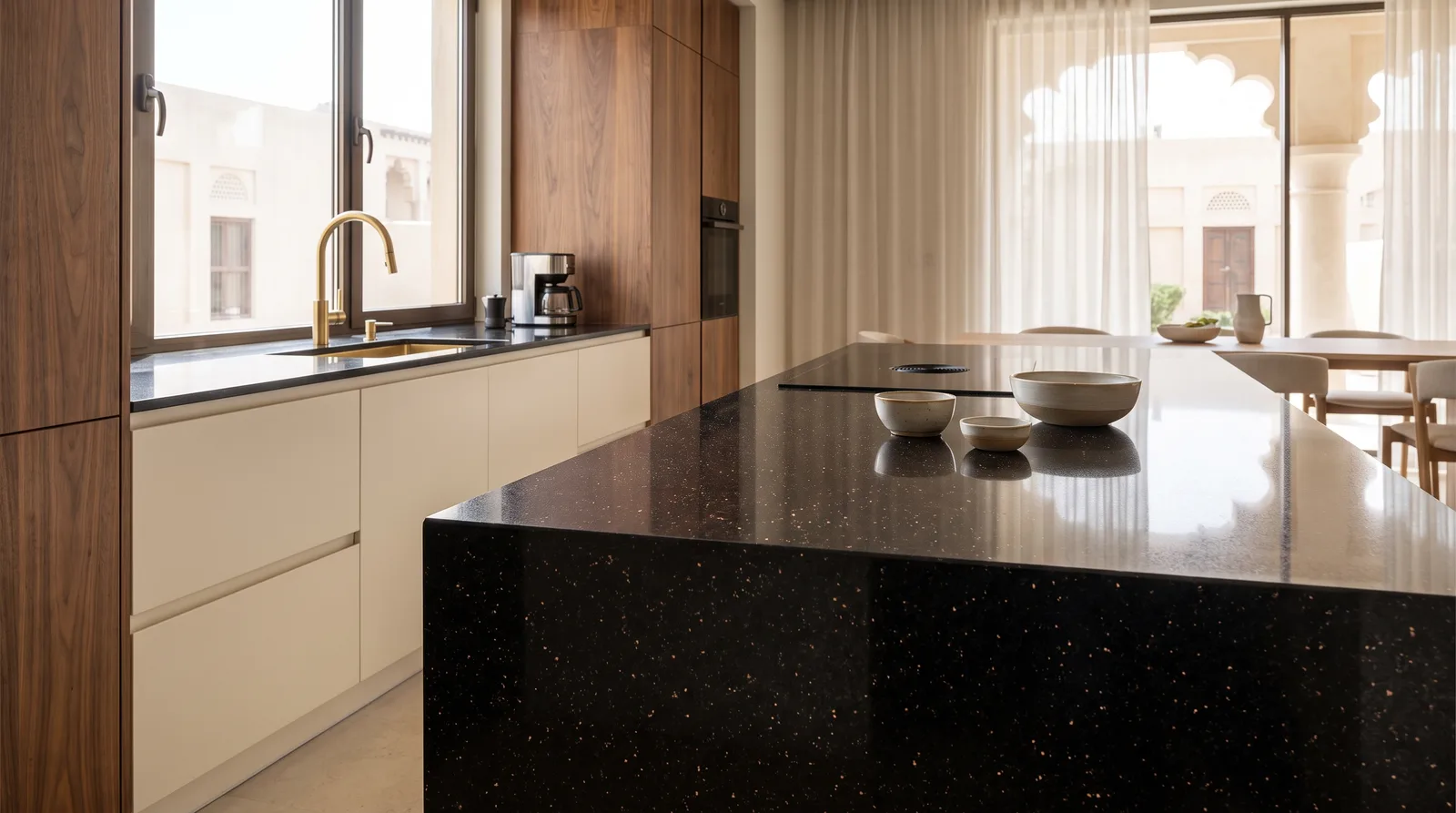
Marble vs Granite in Qatar: Which Is Better for Countertops, Flooring & More?
Marble or granite? For Qatari homes it is one of the most common stone questions — for kitchen countertops especially, but also for flooring, bathrooms and staircases. Both are natural stone, both are beautiful and both last, but they behave very differently in daily use. This is a straight comparison to help you choose the right one for each part of your home, from a supplier who works with both every day.
The quick answer
For kitchen countertops, granite is usually the more practical choice — it is harder, more heat- and scratch-resistant, and shrugs off daily kitchen use. For flooring, staircases, majlis and bathroom walls, marble is usually preferred for its softer, more luxurious veined look. Many Qatari villas use both: granite where it takes a beating, marble where it is seen and admired.
At a glance: marble vs granite
| Factor | Marble | Granite |
|---|---|---|
| Look | Soft, elegant veining; classic luxury | Speckled/grainy; bold, varied colours |
| Hardness | Softer — scratches more easily | Very hard — highly scratch-resistant |
| Heat resistance | Good, but can mark | Excellent — takes hot pans |
| Stain resistance | More porous — needs sealing & care | Denser — more stain-resistant |
| Acid sensitivity | Etches with lemon, vinegar, cleaners | Largely acid-resistant |
| Best for | Flooring, majlis, stairs, bathroom walls, feature areas | Kitchen countertops, high-traffic floors, vanities |
| Maintenance | Higher — seal, avoid acids | Lower — seal occasionally |
| Cost | Wide range; premium marbles are dear | Wide range; often similar to mid marble |
Looks — the first difference
Marble and granite look distinctly different, and this alone decides many choices.
- Marble has soft, flowing veins running through a lighter background — the classic luxurious look of Carrara, Crema Marfil or Emperador. It reads as elegant and timeless, which is why it dominates majlis floors, staircases and feature walls in Qatari homes.
- Granite has a speckled, grainy pattern from its crystals, in a huge range of colours from Black Galaxy to Tan Brown to Colonial White. It reads as bold and hard-wearing rather than soft — a practical, handsome surface.
If you want flowing elegance, marble; if you want a bold, busy pattern that hides everyday marks, granite.
Hardness, heat and scratches
This is where granite pulls ahead for hard-working surfaces.
- Granite is one of the hardest natural stones. It resists scratches from knives and pots, and it takes a hot pan straight from the stove without marking — which is exactly why it is the default for kitchen countertops.
- Marble is softer. It can scratch under knives and scuff over time, and while it tolerates heat reasonably, it is easier to mark. On a floor or a wall this rarely matters; on a busy kitchen worktop it does.
Stains and acid — the real-world test
The difference people notice most in daily life is how each handles spills.
- Marble is more porous and, crucially, acid-sensitive: lemon juice, vinegar, wine and many cleaning products will etch it, leaving a dull mark even when sealed. Sealing helps against staining, but etching is a chemical reaction that sealing does not fully prevent. Marble rewards care.
- Granite is denser and largely acid-resistant. Sealed occasionally, it resists stains and everyday spills well, which makes it far more forgiving in a kitchen or a busy bathroom.
This single factor — acid sensitivity — is the strongest argument for granite in a kitchen and for marble in the calmer, admired parts of the home.
Which to use where, in a Qatari home
- Kitchen countertops: granite (or a hard stone) — heat, knives and acidic food demand it.
- Majlis and reception floors: marble — the veined luxury look is the whole point, and floors don't face knives or lemon.
- Staircases: marble for the feature look; granite where durability matters most.
- Bathroom vanities: granite for the countertop, marble for walls and floors if you want the luxury finish and will care for it.
- Feature walls and cladding: either — marble for elegance, granite for a bold statement.
- High-traffic entrance floors: granite for hardness, or a dense marble if appearance leads.
Maintenance
- Marble needs more care: seal it, wipe spills quickly, avoid acidic and abrasive cleaners, and use a pH-neutral stone cleaner. Over years it can be re-polished to restore its finish — a service Auckland provides.
- Granite is lower-maintenance: seal occasionally, clean with mild soap and water, and it largely looks after itself.
Cost
Both marble and granite span a wide price range depending on the variety, rarity and finish. Entry and mid-range granites and marbles often overlap in price; the extremes are set by rare, highly-figured marbles at the top and common granites at the bottom. In practice, the choice is usually driven by use and look rather than price alone — and for a kitchen, granite's durability often makes it the better value even before looks. Auckland supplies 27+ marble and 26+ granite varieties, so we can match the stone precisely to how and where it will be used.
The bottom line
Marble and granite are not competitors so much as specialists. Granite is the workhorse — hard, heat-proof and forgiving, ideal for kitchens and high-traffic surfaces. Marble is the showpiece — soft, elegant and luxurious, ideal for floors, stairs, majlis and feature areas that are admired more than they are abused. The best homes use each where it belongs, and Auckland supplies, cuts and installs both.
Frequently asked questions
Is marble or granite better for kitchen countertops in Qatar?
Granite is usually better for kitchen countertops. It is harder, more heat-resistant and more scratch- and stain-resistant than marble, and it resists the acidic foods (lemon, vinegar, tomato) that etch and dull marble. Marble can be used in kitchens for its looks, but it needs much more care.
Which is more durable, marble or granite?
Granite is more durable for hard-working surfaces — it is one of the hardest natural stones, resisting scratches, heat and stains well. Marble is softer and more acid-sensitive, so it suits floors, walls, stairs and feature areas rather than surfaces that face knives, heat and spills.
Does marble stain easily?
Marble is porous and acid-sensitive, so it can stain and, more commonly, etch (a dull mark) from acidic spills like lemon, vinegar and wine, even when sealed. Sealing and prompt cleaning reduce staining, but marble rewards careful use. Granite is denser and much more forgiving.
Which is more expensive, marble or granite?
Both span a wide range and often overlap in the mid-market. Rare, highly-figured marbles sit at the top of the price range; everyday granites at the lower end. The choice is usually driven by use and appearance rather than price alone — Auckland supplies both and specifies each where it performs best.
Can you use marble on floors and granite on countertops in the same home?
Yes — and it is the most common approach in Qatari villas. Marble is used for majlis floors, staircases and feature areas for its luxurious veined look, while granite is used for kitchen countertops and high-traffic surfaces for its durability. Auckland supplies and installs both.
Not sure which stone suits which room? Talk to Auckland — we supply, cut and install both marble and granite, and can show you samples for every use.