
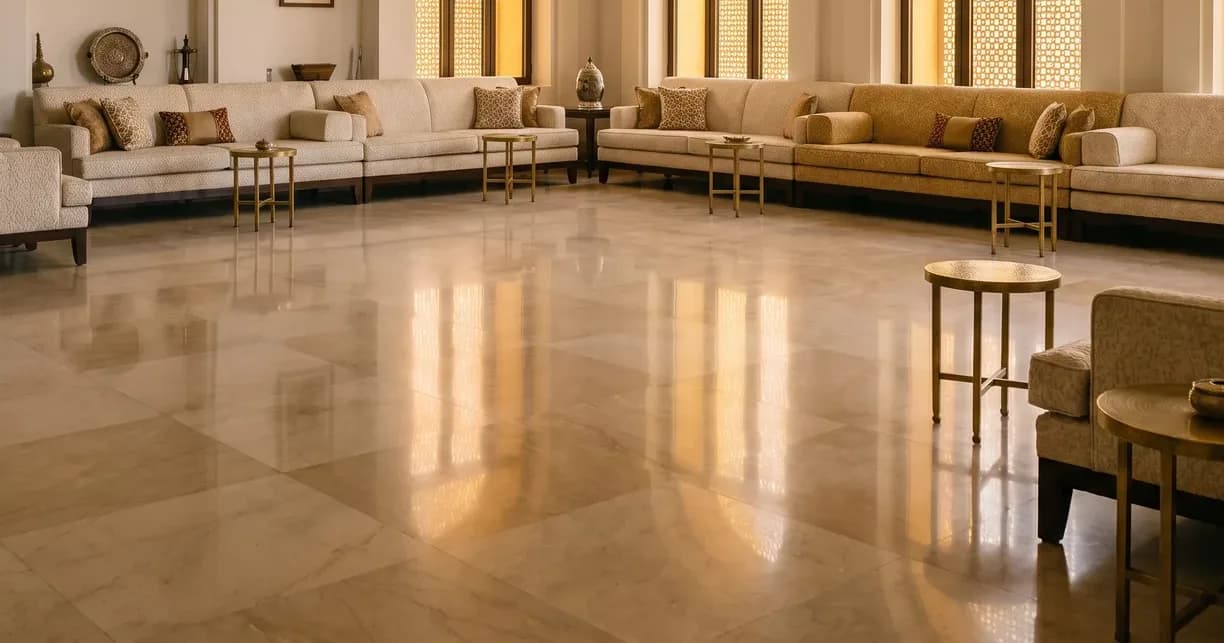
Walk into any showroom in Doha and you will be shown three things that all look like marble: natural marble, marble-look porcelain, and something sold as "artificial marble". On a sample board they can be hard to tell apart. On a majlis floor ten years later, the difference is obvious. As natural stone specialists who have supplied and installed more than 211,000 m² of stone in Qatar since 2011, this is how we explain the difference to our clients, and why natural marble remains the benchmark for the homes that matter most.
The short answer
Natural marble is the material for the spaces that define a premium Qatari villa: the majlis, the entrance hall, the staircase, feature walls and carved detail. It has real depth, every slab is unique, it can be carved and profiled, and it can be restored to a new finish for decades. Porcelain and resin-based "artificial marble" are utility materials. They have a place in service kitchens, laundries and back-of-house rooms, but they imitate marble rather than equal it, and resin products do not belong outdoors in Qatar's sun.
What each material actually is
The names are used loosely in Qatar, so it helps to know what you are being offered.
- Natural marble is limestone recrystallised by heat and pressure over millions of years. The colour and veining run through the full thickness of the stone, and no two slabs are the same. See our natural marble collection for the varieties we supply and install in Qatar.
- Porcelain is a ceramic tile made from refined clay and minerals, fired at very high temperature. By definition it absorbs 0.5% water or less. The "marble" is a high-resolution image printed on the surface; the body underneath is a uniform colour.
- Artificial marble (رخام صناعي) is not one product. In the Gulf market the term covers cultured marble (crushed stone cast in polyester resin, common for basins and vanity tops), engineered stone or quartz (crushed quartz bound with resin, mainly for kitchen worktops), agglomerate marble (marble chips set in resin, sold as tiles) and sometimes solid-surface acrylic. What they share is resin, and resin is what limits them in heat and sunlight.
Side-by-side comparison
| Natural marble | Porcelain (marble-look) | Artificial marble (resin-based) | |
|---|---|---|---|
| Look up close | Unique veining with real depth; slabs can be book-matched | Printed pattern that repeats across tiles | Uniform, often plain or regular veining |
| Character over time | Develops a patina; can be restored to new | Stays the same until it chips | Resin can dull, scorch or yellow |
| Heat and sun | Does not burn or yellow; dense grades work on facades | Fine indoors and outdoors | Indoor use only |
| Restoration | Re-ground and re-polished many times | Chips cannot be polished out; tile is replaced | Light scratches buff out; deep damage is permanent |
| Carving and edges | Carved, moulded and edge-profiled | Mitred edges only | Cast shapes only |
| Care | Sealed; avoid acids such as lemon and vinegar | Minimal | Minimal |
| Where it belongs | Majlis, entrances, staircases, feature walls, facades | Service areas, laundries, back-of-house | Basins and vanity tops indoors |
Our view: natural marble wherever the house is seen and lived in; porcelain only where a room is purely functional; resin products indoors and out of the sun.
Why natural marble remains the benchmark
- Depth you cannot print. Light passes into natural marble and back out through its crystals, which is why a polished marble floor glows rather than shines. Printed porcelain reflects light off the surface only.
- Every slab is unique. Large slabs can be book-matched so the veining mirrors across a wall or floor. A printed tile repeats the same few faces, and across a large majlis the repetition shows.
- It can be shaped. Only natural stone can be cut into solid stair treads with profiled nosings, matching skirtings, carved columns, capitals and cornices. Porcelain can only be mitred.
- It can be restored, not replaced. Because the colour runs through the stone, a worn marble floor can be ground and polished back to new many times over its life. A worn porcelain floor can only be torn out.
- It is what a premium home is judged by. In Qatar the majlis and the entrance are where guests form their impression of a house, and natural stone is the material those rooms are expected to be.
What changes in Qatar's climate
Most comparisons online are written for Europe or the US. Three things work differently here.
Sun and heat outdoors. Resin is the weak point of artificial marble. Under strong UV and surface temperatures that can pass 60°C in summer, resin-based products can yellow, fade or warp, which is why most manufacturers do not warranty them outdoors. On villa facades we install dense natural stone, mechanically fixed in stainless steel, because it is built to take the Gulf's heat cycle; see Omani stone on facades for how the grade and finish are chosen.
Fine sand is an abrasive. Qatar's dust is carried into every house. On a high-gloss marble floor it acts like fine sandpaper, so the busiest entrances lose their shine sooner. The expert answer is in the specification: a honed finish where traffic is heaviest, polished marble where it is admired, and periodic professional polishing as part of aftercare.
Cleaning routines. Daily wet mopping with strong cleaners, common in larger households, is hard on marble because acids etch it. We recommend a pH-neutral cleaning routine for every marble floor, and in purely functional wet rooms porcelain is the practical surface.
Where we specify natural marble
- The majlis and reception halls, with large slabs, book-matched veining and a deep polish.
- Entrance halls and staircases, with solid treads, profiled nosings and matching skirtings cut in our own factory.
- Feature walls, columns and carved detail, CNC-carved from the same stone as the floor.
- Floors you expect to keep for decades, because marble is restored rather than replaced.
For room-by-room advice on which marble to choose, see the best marble for flooring in Qatar and our marble flooring service in Doha.
Where a substitute has a place
An expert specification is also honest about where marble is not the right material:
- Service kitchens, laundries and back-of-house rooms, where spills and heavy cleaning are constant and nobody sees the floor, porcelain is the practical surface.
- Basins and vanity tops can be cast in one piece from cultured marble or solid surface with an integrated basin.
- Kitchen worktops are better in granite than in marble, because marble etches with lemon and vinegar; our marble vs granite guide explains why.
One caution on engineered quartz: cutting it releases fine crystalline silica, a serious health risk to fabricators, and Australia banned engineered stone from July 2024 for that reason.
Marble is an asset; porcelain is a finish
A natural marble floor that has dulled or scratched is ground and re-polished in place, and comes back looking new. As a 2026 planning guide, professional polishing in Qatar runs about QAR 25–60 per m² (see the marble polishing cost guide), and it can be repeated years later. Porcelain cannot be refinished: a chipped tile has to be cut out, and matching it is difficult once the production batch or design has gone. Resin that has yellowed or scorched cannot be brought back either.
That is why we describe natural marble as an asset that is maintained, and porcelain as a finish that is eventually replaced.
How to tell natural marble from an imitation
- Look at the edge or the back. Natural marble shows its veining through the thickness. Most porcelain shows a plain clay body under a printed top surface.
- Lay out several tiles. Printed porcelain repeats the same few patterns; real marble never repeats.
- Check the weight and the sound. Natural stone is heavy and dense. Resin products feel lighter and sound duller when tapped.
- Ask about origin. A genuine marble specialist can tell you the quarry country and the variety (for example Omani, Carrara or Crema Marfil) and show you full slabs, not just small samples.
How Auckland delivers a marble floor
1. Consultation. Our team reviews the rooms, traffic and lighting, and recommends the variety, thickness and finish for each space. 2. Slab selection. You choose the actual slabs, so the veining is matched to the room before anything is cut. 3. Fabrication. Floors, stair treads, nosings, skirtings and carved elements are cut and finished in our own factory in Doha. 4. Installation. Our own crews lay and level the stone, then hone or polish it on site to the finish you chose and seal it. 5. Aftercare. We advise on the cleaning routine and can return to polish and restore the floor in the years ahead.
Frequently asked questions
Is porcelain cheaper than marble in Qatar?
Usually, yes, to buy. Natural marble is a different kind of purchase: it can be restored rather than replaced, it can be carved and book-matched, and it carries the depth and character that define a premium home. Over the life of a well-kept floor, that is what clients are paying for.
What is artificial marble, or رخام صناعي?
It is a general name for resin-based imitation stone: cultured marble for basins and vanity tops, engineered quartz for worktops, agglomerate marble tiles, and sometimes acrylic solid surface. These products resist stains but do not tolerate high heat or direct sun, so they belong indoors.
Does natural marble fade or crack in Qatar's heat?
Indoors, no. Natural marble does not burn, yellow or soften in heat. Outdoors, choose dense grades with a honed or flamed finish rather than polished, fixed mechanically on facades. Some strongly coloured marbles can lighten in direct sun, which is why white and cream stones are the usual choice for Qatari facades.
Can scratched porcelain be polished like marble?
No. Porcelain's pattern is printed on the surface, so grinding it would remove the design, and damaged tiles have to be replaced. Natural marble can be ground and re-polished many times because its colour runs through the stone.
Which is best for a majlis floor?
Natural marble. A majlis is a large, formal room where veining, slab size and a deep polish make the biggest difference, and where the floor is expected to last for decades. We often recommend a honed finish near the entrance and a polished finish across the main floor.
Planning a majlis, entrance or staircase in natural marble? Auckland supplies, fabricates, installs and restores natural marble across Qatar, from Omani and Turkish to Italian and Spanish varieties. Book a consultation, or visit our factory in Doha to see the slabs.