
Mechanical vs Adhesive Stone Cladding: Why Dry Fixing Wins in the Gulf
When people plan a stone facade in Qatar, they spend weeks choosing the stone and almost no time on how it is fixed to the wall. That is a mistake. In the Gulf, the fixing method decides whether a facade lasts for decades or starts dropping panels in a few years. There are two main approaches — adhesive (wet) fixing and mechanical (dry) fixing — and on a tall, sun-exposed Qatari facade they are not equal.
How adhesive (wet) fixing works
Adhesive fixing bonds each stone panel directly to the wall with cement mortar or a stone adhesive. It is the cheaper, faster method, and it is perfectly fine for low walls, garden features and interior surfaces. The weakness shows up on tall, exposed elevations: as the building and the stone heat up and cool through Qatar's daily temperature swing, the bond is stressed. Over time, panels can crack, debond, or — in the worst case — fall, which is a serious safety risk on a multi-storey facade.
How mechanical (dry) fixing works
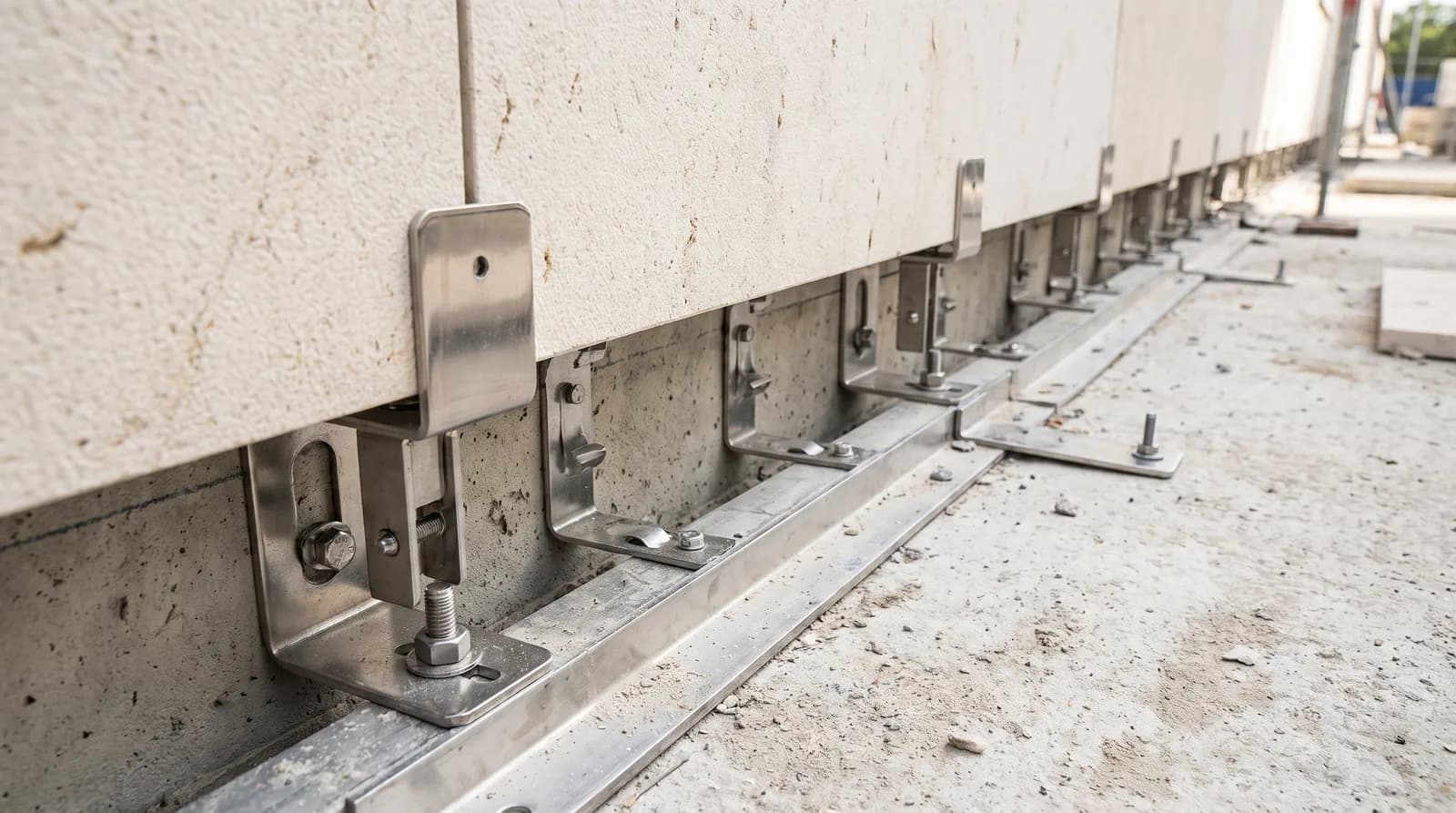
Mechanical fixing anchors each panel to the structure with stainless steel brackets and angles, leaving a small ventilated cavity behind the stone. Instead of relying on adhesion, each panel is held individually by hardware engineered for the load. Auckland uses 304 and 316 marine-grade stainless steel, specified per project for Qatar's coastal, humid and salt-laden environment, where lesser metals would corrode.
Why mechanical fixing wins in the Gulf
Three reasons. First, movement: each panel moves independently, so thermal expansion is absorbed rather than cracking the facade. Second, the cavity: it ventilates the wall, helps with insulation, and lets any moisture drain away instead of being trapped against the building. Third, serviceability: because panels are individually anchored, a single damaged panel can be removed and replaced without disturbing the rest of the facade — something that is almost impossible with bonded cladding.
The safety and durability case
On tall buildings, falling cladding is a genuine hazard, and many authorities increasingly expect mechanically fixed stone on higher facades for exactly this reason. Mechanical fixing also simply lasts longer: with corrosion-resistant stainless steel and independent panel movement, a dry-fixed facade is engineered to handle decades of Gulf heat without the cracking and debonding that affects adhesive systems.
When adhesive fixing is still fine
This is not about never using adhesive. For interior cladding, low garden and boundary walls, and small feature areas where heat movement and height are not a concern, adhesive fixing is cost-effective and entirely appropriate. The key is matching the method to the exposure: the more height and sun a facade faces, the stronger the case for mechanical fixing.
How Auckland fixes facades
For facade and exterior wall cladding, Auckland uses mechanical (dry) fixing with 304 and 316 stainless steel angle systems as standard, with the system designed per project to accommodate thermal movement and allow individual panel replacement. It costs a little more upfront than adhesive, and it is the reason our facades keep performing through Qatar's heat. Learn more on our cladding and fixing systems page, or book a site assessment.
Frequently asked questions
Why is mechanical fixing better than adhesive for facades in Qatar?
Mechanical fixing anchors each panel independently with stainless steel, so it absorbs thermal movement, ventilates the wall and stays durable in Gulf heat — far more reliable than adhesive alone on tall, sun-exposed facades.
What grade of stainless steel is used?
Auckland uses 304 and 316 (marine-grade) stainless steel, specified per project for corrosion resistance in Qatar's coastal, humid environment.
Can a single damaged stone panel be replaced?
Yes. Because each panel is individually anchored in a mechanical system, a single panel can be removed and replaced without redoing the surrounding cladding.
Planning a facade and want it built to last? Learn more about our cladding and fixing systems, or book a site assessment anywhere in Qatar.