
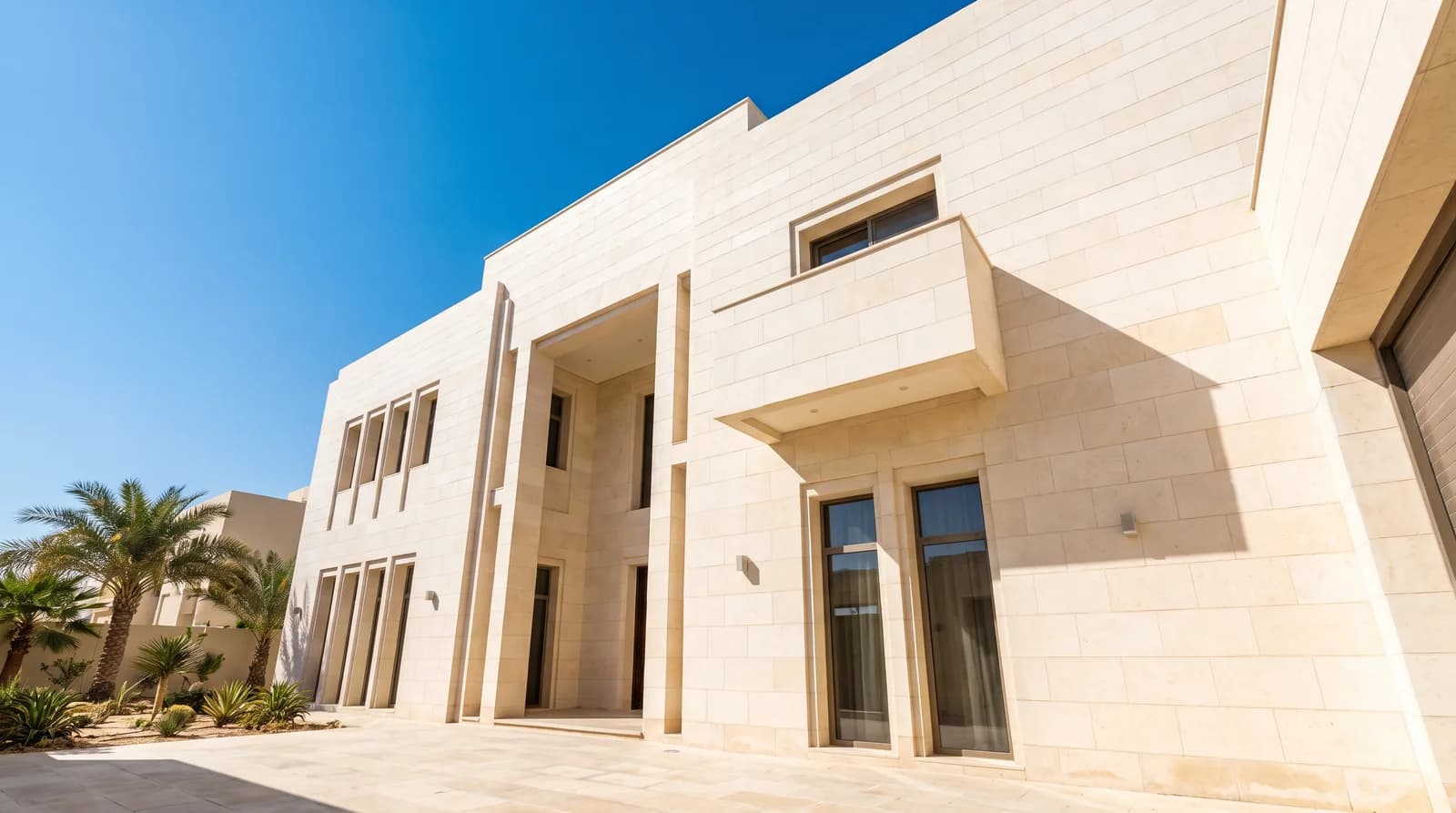
Across Doha, Lusail and Al Wakrah, the same problem shows up on villa after villa: hairline cracks creeping across a once-perfect facade, paint peeling at the corners, and dark stains spreading after the humid season. In Qatar's climate, the wrong facade finish simply does not last. This guide explains why villa facades fail in the Gulf, and why dense natural stone cladding — Syrian stone in particular — is the material that survives.
Why villa facades crack in Qatar's climate
Qatar's environment is uniquely hard on building exteriors. In summer, the surface of a sun-facing wall can pass 60°C during the day and then cool sharply overnight. That daily expansion and contraction stresses every material on the wall. Add constant coastal humidity and salt-laden air, and you have ideal conditions for finishes to fail. Paint and synthetic render are the first to go: they are thin, rigid and bonded directly to the wall, so when the substrate moves they blister, crack and let moisture in behind them.
The role of thermal expansion
The technical culprit is thermal expansion. Every material has a coefficient of thermal expansion — how much it grows and shrinks with temperature. When a coating and the wall behind it expand at different rates, the bond between them is stressed again and again until it fails. Dense natural stone has a low, stable expansion rate, and when it is mechanically fixed each panel can move independently — so it absorbs these forces instead of cracking.
Why Syrian stone outperforms paint and coatings
Syrian stone, quarried in the Homs and Palmyra regions, is prized across the Gulf for its exceptional structural density. That density gives it three advantages in Qatar: it barely moves with heat, it has very low water absorption (typically under 0.5%), and it is strong enough to last for decades on an exposed elevation. Where paint needs redoing every few years, a Syrian stone facade installed correctly can outlive the rest of the building's finishes — which is exactly why it is the most requested cladding material for villas and palaces in Doha.
Omani marble and limestone: the alternatives
Syrian stone is not the only natural option. Omani marble offers similar density with a more luxurious, veined appearance for entrances and feature walls. Jordanian limestone is a softer natural stone that still far outperforms paint; it is best suited to boundary walls and lower elevations rather than full sun-facing facades. The common thread is that natural stone, as a category, dramatically outperforms synthetic coatings in the Gulf — the choice is really which stone fits the architecture and the exposure.
A natural insulator that cuts cooling costs
There is a performance bonus beyond durability. Dense stone is effective thermal mass: it slows the transfer of heat into the building, which helps stabilise indoor temperatures and reduces the load on air-conditioning. Over a single Qatari summer — and over the decades a villa stands — that adds up to meaningful energy savings, on top of the repair and repainting you avoid.
The look: permanence over a surface coat
There is no contest aesthetically either. Natural stone reads as solid and permanent, and its variation in tone and texture is something paint can only imitate. A Syrian stone facade signals quality the moment you arrive, and it ages gracefully rather than degrading. For high-end villas and commercial buildings across Qatar, that lasting perception of value matters as much as the engineering.
How Auckland installs facades that last
Material is only half the story — installation decides whether a facade survives. Auckland imports premium Syrian stone directly from vetted quarries, CNC-cuts it to exact dimensions, and installs it using mechanical (dry) fixing with marine-grade stainless steel, so each panel is anchored independently and movement is absorbed safely. The result is a stone facade engineered for Qatar's heat from the material outward.
Frequently asked questions
Why does paint crack on villa facades in Qatar?
Paint and synthetic coatings are thin, rigid and bonded directly to the wall. Qatar's extreme heat-and-humidity cycle makes the wall expand and contract, stressing that bond until the coating blisters, cracks and lets moisture in behind it.
Is Syrian stone better than paint for a facade?
Yes. Syrian stone's high density and very low water absorption resist the thermal expansion and humidity that destroy paint, and a correctly installed stone facade can last decades versus the few years paint survives in the Gulf.
Does natural stone cladding reduce cooling costs?
Dense natural stone acts as thermal mass, slowing heat transfer into the building and easing the load on air-conditioning — a genuine saving across a Qatari summer.
Thinking about a new facade, or replacing one that is already failing? Use our facade cost calculator for an instant estimate, or book a site consultation anywhere in Qatar.