
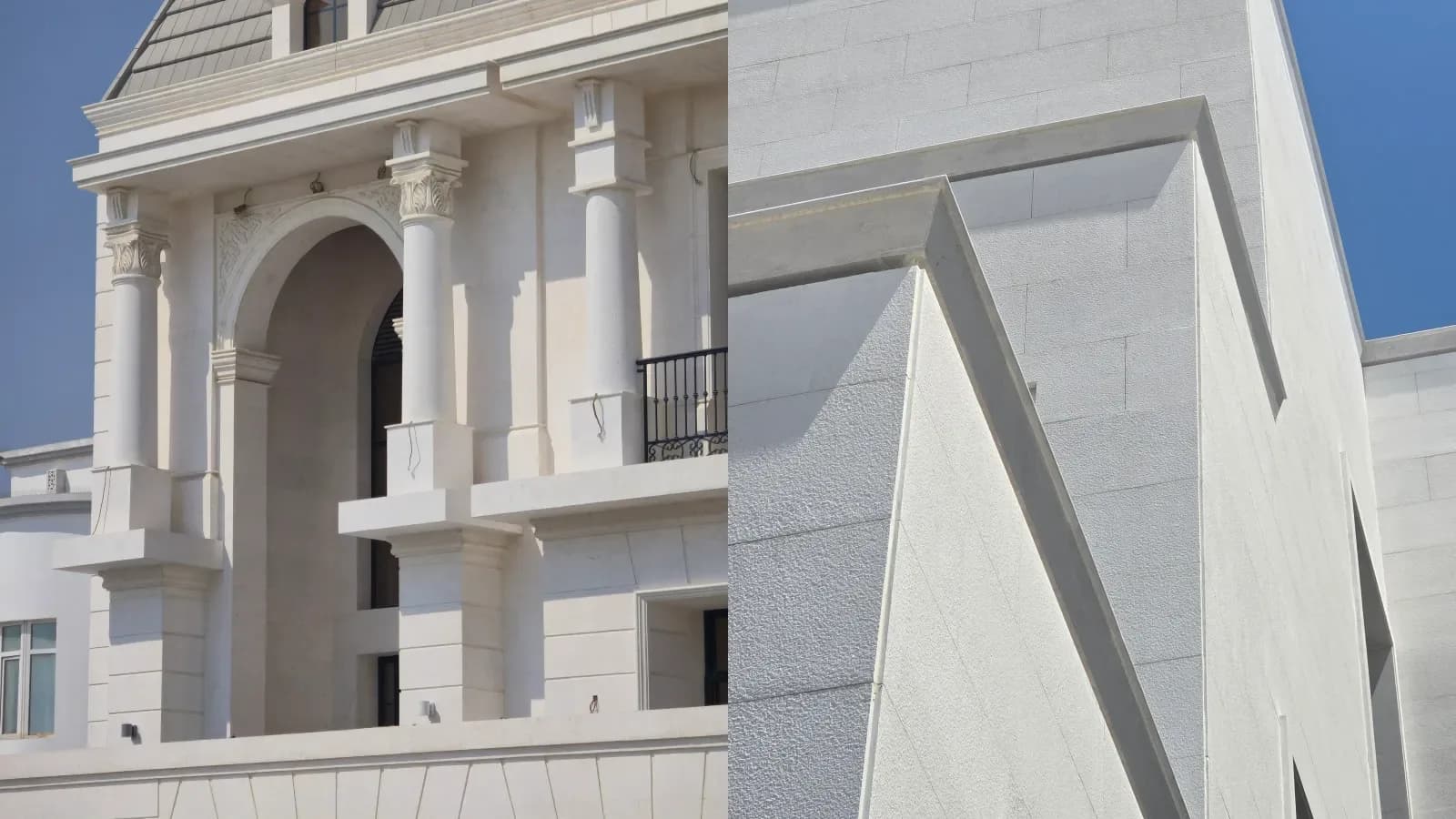
Before you choose a single stone, you choose a language. Almost every villa facade in Qatar speaks one of two: classical — columns, arches and carved detail — or modern — clean planes, sharp lines and large-format stone. The style you pick shapes everything after it: which stone works, how much carving the job needs, what it costs, and how it ages. This guide lays out both, with real projects we've built in Doha, so you can decide what suits your villa before you commit.
The two design languages of Qatari villas
Drive through Doha's villa districts and the split is obvious. One villa wears a columned portico, a carved cornice and an ornate entrance arch. The next is a bold composition of flat white planes and deep shadow lines, with almost no ornament at all. Both can be stunning in natural stone; they simply set out to do different things.
Classical aims for presence through detail and tradition — it reads as grand, established and permanent. Modern aims for presence through form and restraint — it reads as clean, confident and architectural. Neither is "better." The right choice depends on your taste, your plot, the neighbours, and how much detail you want to live with and maintain.
Classical facades: columns, arches and carved stone
A classical facade is built from a vocabulary that is thousands of years old: columns and pilasters, capitals and bases, arches, cornices, moulded window surrounds, keystones and balustrades. Done properly, none of this is applied plaster trim — it is solid natural stone, carved and fixed.
This is the harder facade to build well, because every carved element has to be accurate and every repeated piece has to match across the whole elevation. It is also the style that most rewards a contractor who can carve stone in-house.
Two of our recent Doha projects show the range within "classical":
- The Ain Khaled classical villa is the heavily-detailed end — carved Corinthian columns and capitals, an arched entrance with ornamented spandrels, deep cornices and moulded surrounds across roughly 1,500 m² of Syrian stone.
- The Abu Hamour grand villa is the refined, monumental end — around 2,000 m² of Syrian stone with fluted pilasters, tiered cornices and keystoned window surrounds, kept crisp and consistent at a very large scale.
Classical suits owners who want a traditional, prestigious home, and it pairs naturally with warm-white and cream stones that show carving beautifully.
Modern facades: clean lines and large-format stone
A modern facade drops the ornament and lets the stone, the massing and the light do the work. The details that matter are different: large-format panels, tight and even coursing, deep reveals around windows, sharp mitred corners, and a stepped or faceted massing that throws crisp shadows.
It sounds simpler, but flatness and alignment become everything. On a plain modern elevation there is no cornice or column to hide behind — a single panel out of plane is visible from the street, so the fixing system and the fabrication tolerance have to be excellent.
Our Lusail Qetaifan Island residence is a clear example: a grand modern facade in bright white Omani stone, large-format panels wrapped around a faceted, stepped massing, with deep projecting cornices and layered reveals doing the work that carving does on a classical house. Modern suits owners who want a contemporary, architectural look, and it pairs well with clean white stones and, often, a bush-hammered texture on accent faces for contrast.
Which stone suits which style
The style narrows the stone choice more than most owners expect.
Best stone for a classical facade
Classical facades live or die on carving, so the stone has to hold fine detail without crumbling. Syrian stone (Jabal al-Zawiya) is the Qatari default — dense, warm-white, and prized precisely because it carves cleanly and resists the heat. Omani marble is the step up for bright-white columns and grander carved work. Warm Jordanian limestone is a softer, understated natural option that suits traditional detailing on walls and secondary elevations.
Best stone for a modern facade
Modern facades want a clean, consistent field, so colour uniformity and large formats matter more than carvability. Bright Omani stone and white Syrian stone both give the crisp, monolithic look modern designs are after. Because there is little ornament, the finish carries the interest — many modern facades mix honed panels with bush-hammered textured faces so the elevation reads with depth rather than as one flat surface.
Does a classical facade cost more than a modern one?
Usually, yes — and the reason is labour, not material. The stone itself is priced by area and grade either way. What moves the price is the carving and the number of bespoke pieces: columns, capitals, cornices, arches and moulded surrounds all take fabrication time and skilled hand-finishing that a plain modern panel does not.
That said, a modern facade is not automatically cheap. Large-format panels, demanding flatness tolerances and premium bright-white stone can push a "simple" modern elevation up to — or past — a lightly-detailed classical one. The honest answer is that the design drives the cost far more than the label, which is why both styles are quoted from your actual drawings rather than a per-metre sticker. For a sense of the numbers, see our Syrian stone facade cost guide.
Maintenance and longevity
Both styles are natural stone, so the fundamentals are the same: mechanically fixed with stainless steel, sealed against staining, and built to move with Qatar's heat instead of cracking. A well-built stone facade of either style lasts for decades.
The practical difference is cleaning. A classical facade has more ledges, mouldings and carved recesses where dust and sand collect, so it takes a little more effort to keep pristine. A modern facade with fewer horizontal ledges sheds dust more easily. It is a minor factor, but worth knowing if low upkeep is a priority.
How to choose the right style for your villa
A few honest questions settle it faster than any mood board:
- What do you actually love? Look at villas you admire and notice which language they speak. Taste should lead.
- What fits the plot and the street? A grand classical facade needs room and the right setting to read well; a modern facade can suit a tighter, contemporary plot.
- How much detail do you want to maintain? More carving means more character and slightly more cleaning.
- Who is building it? Classical especially rewards a contractor who carves stone in-house, so the columns and cornices actually match. Ask to see finished carved work before you sign.
Still unsure? The clearest step is to look at completed facades in both styles and talk through your plot with someone who builds them. Auckland supplies, fabricates and installs classical and modern stone facades across Doha and Qatar, with our own carving workshop and installation crews. Explore the classical and modern projects above, then book a consultation.
Frequently asked questions
Is a classical or modern facade better for a villa in Qatar?
Neither is objectively better — it comes down to taste, the plot and upkeep. Classical facades (columns, arches, carved cornices) read as grand and traditional and suit owners who want ornate detail. Modern facades (clean planes, large-format stone, sharp lines) read as contemporary and architectural and are slightly easier to keep clean. Both perform equally well in Qatar's climate when built in mechanically-fixed natural stone.
Which natural stone is best for a classical villa facade?
Syrian stone from Jabal al-Zawiya is the most popular choice for classical facades in Qatar because it is dense, warm-white and holds fine carving without crumbling, while resisting the heat. Omani marble is used for brighter, grander carved columns, and warm Jordanian limestone is an understated option that suits traditional detailing on walls and secondary elevations.
Does a classical stone facade cost more than a modern one?
Usually yes, because classical facades need far more carving and bespoke fabrication — columns, capitals, cornices and moulded surrounds all take skilled hand-finishing. But a modern facade with large-format panels, tight flatness tolerances and premium white stone can cost just as much. The design detail drives the price more than the style label, so both are quoted from your drawings.
Planning a villa facade? Auckland builds both classical and modern natural stone facades across Doha and Qatar — supplied, carved and installed by one team. See our projects above and book a consultation.