
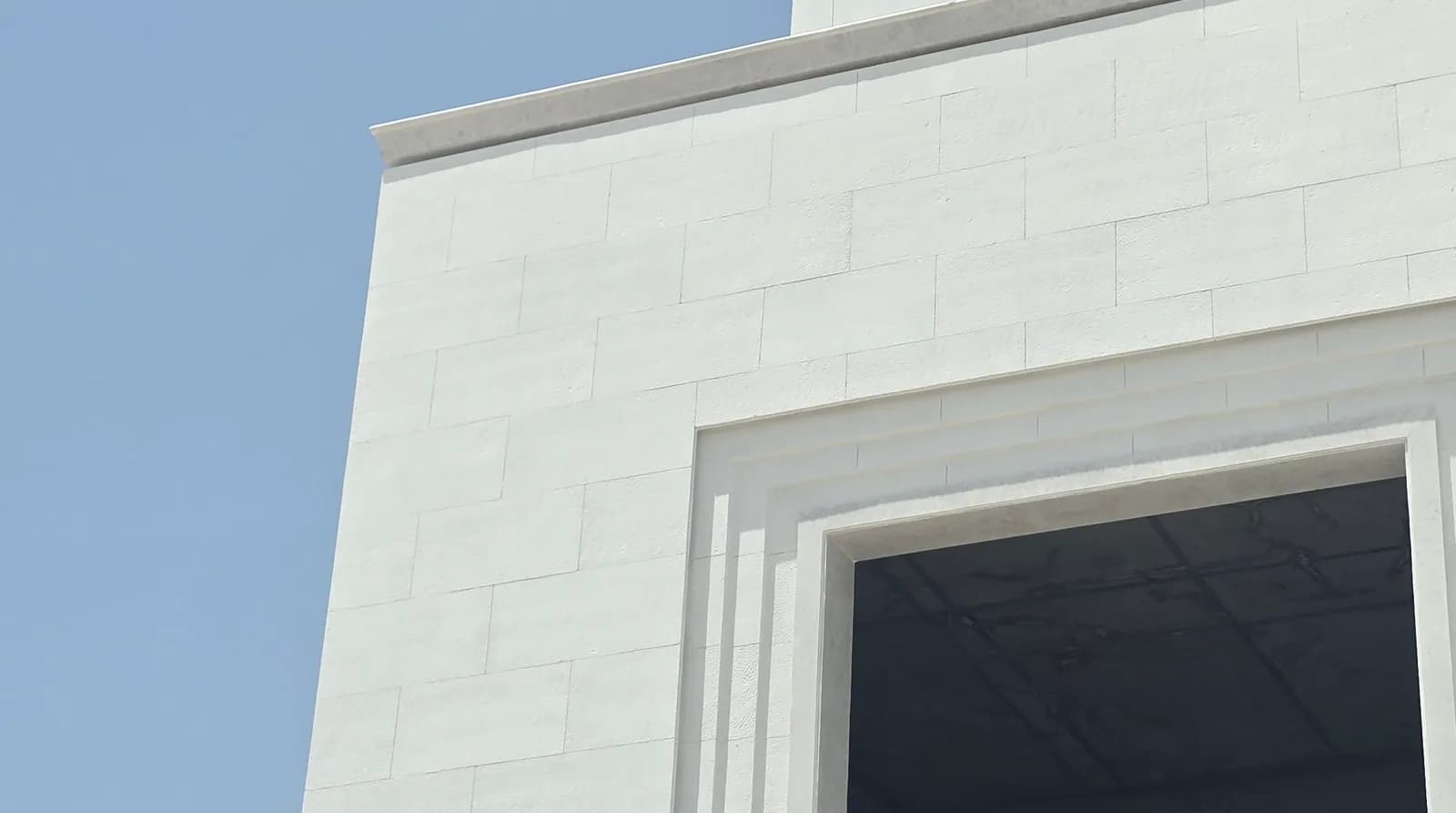
Omani Stone vs Syrian Stone for Villa Facades in Qatar: Which Should You Choose?
If you are cladding a villa facade in Qatar, two natural stones will come up again and again: Omani stone and Syrian stone. They are the two most popular facade stones in the country for good reason — both are dense, both handle the Gulf heat, and both look beautiful on a Qatari villa. But they are not the same, and the right choice depends on the look you want, the detailing and the architecture. This is a straight, honest comparison to help you decide — from a contractor who imports, carves and installs both.
The quick answer
If you want the brightest, most prestigious white facade and fine carved columns and capitals, Omani stone is usually the choice. If you want a warm cream-to-golden classical villa with rich, traditional carved detail, Syrian stone is usually the choice — and it is Qatar's most popular facade stone for exactly that reason. Both are excellent; the rest of this guide is about matching the stone to your villa.
At a glance: Omani stone vs Syrian stone
| Factor | Omani stone | Syrian stone |
|---|---|---|
| Colour | Bright ivory-to-white | Warm cream to golden |
| Look | Prestigious, clean, modern-classical | Traditional, warm, classical |
| Carving | Excellent — dense, holds crisp detail | Excellent — carves cleanly, ideal for ornate work |
| Durability in Qatar | Very high — dense, low absorption | Very high — dense, heat- and crack-resistant |
| Typical cost | From ~230 QAR/m² | From ~170 QAR/m² |
| Best for | Bright modern & modern-classical villas, feature columns | Classical villas, carved detail, large facades |
| Popularity in Qatar | Premium choice | The most popular facade stone |
*Prices are indicative per-square-metre supply-and-install ranges and vary with thickness, finish and detailing.*
Colour and character
This is the difference most people notice first.
- Omani stone is a bright, clean ivory-to-white. It gives a villa a crisp, prestigious, almost palatial look, and it is the go-to when an owner wants that bright white-stone facade that reads as high-end from the street. It suits modern and modern-classical architecture especially well.
- Syrian stone runs warmer — a cream to soft golden tone (the exact shade depends on the grade, from bright White Syrian to warmer Sarmada and Aleppo). It gives the traditional, warm, classical villa look that is deeply associated with Qatari homes.
Neither is "better" — it is the look you are after. Bright and modern leans Omani; warm and classical leans Syrian.
Carving and detail
Both stones carve beautifully, which is why both are used for columns, capitals, cornices and mouldings — but there is a nuance.
- Omani stone is dense and holds very crisp detail, which makes it excellent for bright carved columns and capitals where you want the carving to read sharp and clean against a white surface.
- Syrian stone carves cleanly and is the traditional choice for richly ornamented classical facades — the cornices, keystones, balustrades and mouldings of a heavily-detailed villa. At scale, it carries that detail consistently across the whole facade.
In practice, many Qatari villas use both: a Syrian stone body with Omani feature columns, or vice versa. Because we fabricate both in-house, mixing them on one facade is straightforward.
Durability in Qatar's climate
Here the two are very close, and both are strong. Both Omani and Syrian stone are dense, low-absorption stones that resist Qatar's heat and the crack-and-spall problems that ruin softer or wrongly-chosen stone. Both stand up well near the coast when sealed and — critically — when mechanically (dry) fixed rather than glued. The durability difference between them is small; the far bigger durability factor is how the facade is fixed and sealed, not which of these two stones you pick. (See our guide on mechanical vs adhesive fixing for why this matters more than the stone itself.)
Cost
Both are premium natural stones; the difference in cost reflects character more than quality.
- Syrian stone typically starts from around 170 QAR/m² supplied and installed. For a large classical villa with a lot of carved detail, it delivers the richest traditional character.
- Omani stone typically starts higher, from around 230 QAR/m², reflecting its brighter, more premium character. It is the choice when the bright white look and prestige are worth the difference.
Both are a fraction of European stones like Portuguese or Turkish marble, so the Omani-vs-Syrian decision is really about look, light and architecture. Use our facade cost calculator to estimate either for your villa's area.
So which should you choose?
- Choose Omani stone if: you want the brightest, most prestigious white facade; your villa is modern or modern-classical; you want crisp carved feature columns to stand out; and the premium is worth it to you.
- Choose Syrian stone if: you want a warm, traditional classical villa; you have a lot of carved detail across a large facade; or you simply prefer the warmer cream-golden tone.
- Choose both if: you want a bright body with warm carved accents, or a warm body with bright feature columns — a combination that is common and looks superb.
Why the contractor matters more than the stone
The honest truth: with two stones this good, the biggest risk to your facade is not which one you pick — it is who installs it. A beautiful stone fixed badly, with mismatched carving or the wrong (adhesive) fixing for the heat, will disappoint whichever stone it is. Auckland imports both Omani and Syrian stone directly, carves columns and cornices on its own CNC line, and installs with its own crews using mechanical dry-fixing engineered for the Gulf. That means the stone you choose is fabricated and fitted by one accountable team — so the facade looks right and stays right for decades.
Frequently asked questions
Is Omani stone or Syrian stone better for a villa facade in Qatar?
Neither is universally better — they suit different looks. Omani stone gives a brighter, more prestigious white facade and is ideal for modern or modern-classical villas and crisp carved columns. Syrian stone gives a warm cream-to-golden classical look, carries rich carved detail beautifully, and performs superbly at scale — which is why it is Qatar's most popular facade stone. Both are dense and durable in Qatar's heat.
What is the difference in colour between Omani and Syrian stone?
Omani stone is a bright ivory-to-white, giving a crisp, prestigious, modern-classical look. Syrian stone is warmer — cream to soft golden, depending on the grade (White Syrian, Sarmada, Aleppo) — giving the traditional warm classical villa look most associated with Qatari homes.
Which is more expensive, Omani or Syrian stone?
Omani stone is typically the more expensive of the two, starting from around 230 QAR/m² supplied and installed, reflecting its brighter, more premium character. Syrian stone typically starts from around 170 QAR/m², and its warmth and carving quality make it the most popular facade stone in Qatar. Exact prices vary with thickness, finish and carved detailing.
Can you use both Omani and Syrian stone on the same facade?
Yes, and it is common. Many Qatari villas pair a Syrian stone body with bright Omani feature columns, or a bright Omani facade with warm carved accents. Because Auckland fabricates both stones in-house on the same CNC line, combining them on one facade is straightforward and looks superb.
Which stone is more durable in Qatar's heat?
Both Omani and Syrian stone are dense, low-absorption stones that resist Qatar's heat and cracking, and the durability difference between them is small. The far bigger factor in how long a facade lasts is how it is fixed and sealed — a mechanically (dry) fixed, sealed facade in either stone will outlast a badly glued one in any stone.
Still deciding between Omani and Syrian stone for your villa? Talk to Auckland — we supply, carve and install both, and can show you samples and finished facades in each.