
You can clad an entire villa in beautiful stone and it will still feel ordinary if the entrance is flat. The opposite is also true: a well-composed grand entrance makes the whole house read as a landmark from the street. In Qatar's high-end villa and palace architecture, the entrance is where the money shows — and where real stone craftsmanship separates a memorable home from a merely large one. This is a design guide to the grand stone entrance: the elements, the choices, and how they come together.
Why the entrance carries the whole facade
The eye goes to the entrance first. It is the tallest, most detailed, most framed part of the elevation, and it sets the tone for everything else. Get it right and a relatively simple facade around it feels grand by association. Get it wrong — flat, under-scaled, or in a material that cheapens up close — and no amount of stone elsewhere rescues it. So on a luxury villa, the entrance deserves the best material, the most detail, and the most careful proportion.
The elements of a grand stone entrance
A grand entrance is a composition of a few classical elements. You don't need all of them — but the best entrances use several in proportion.
Columns and the portico
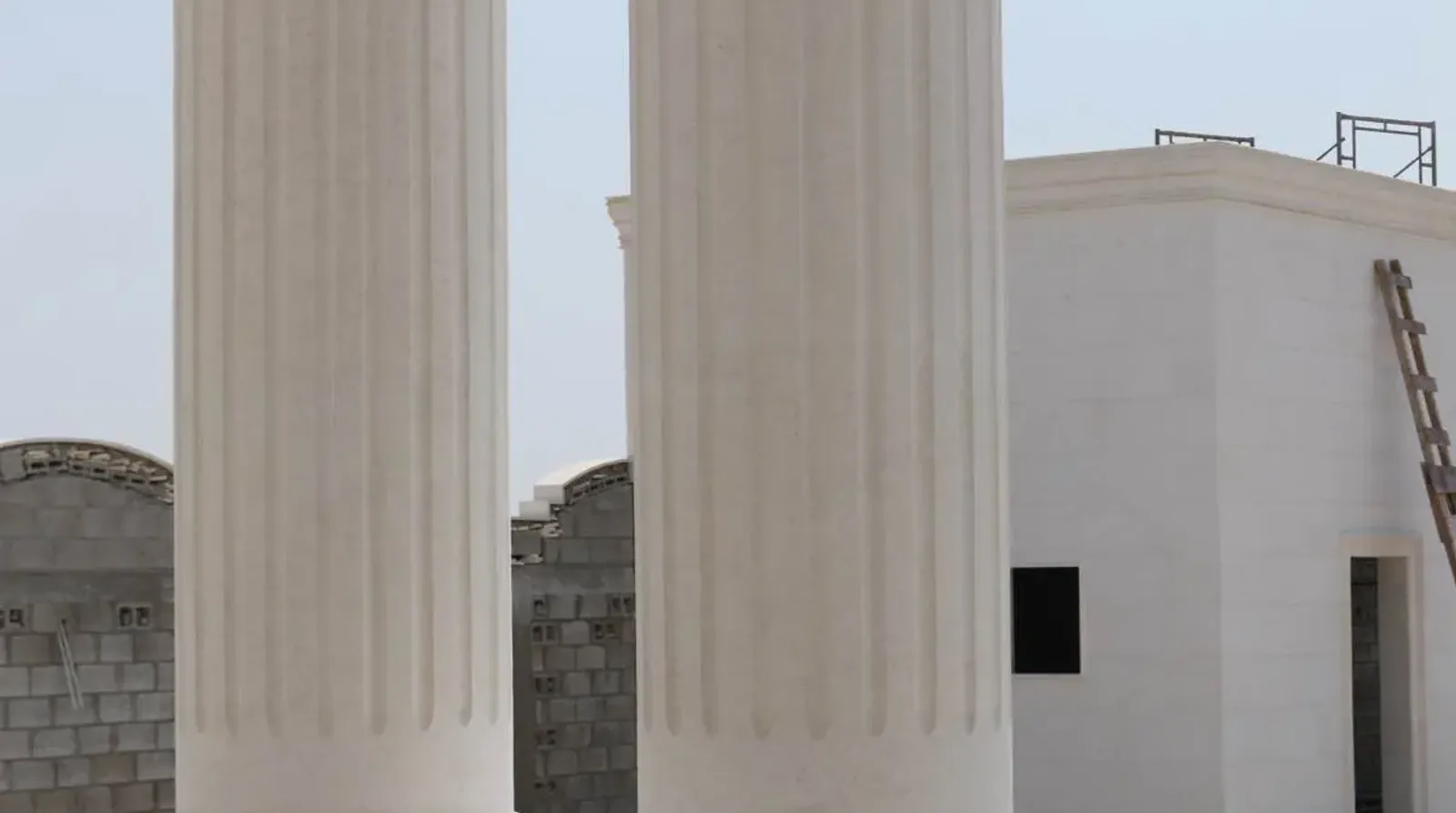
Columns are the single most powerful move. A pair or colonnade of full stone columns carrying a portico gives instant height, shadow and presence. The order sets the character: fluted shafts with carved Corinthian capitals read as ornate and palatial; plain or lightly-tapered shafts read as modern-classical and restrained. Real carved-stone columns — not plaster or GRC pretending to be stone — are what make this read as permanent and expensive up close.
Capitals and bases
The capital is where the carving skill shows most. Corinthian acanthus, Ionic scrolls or a custom design — a well-carved capital is the jewellery of the entrance. Matched bases and plinths ground the columns and keep the proportion correct.
The arch and entrance surround
An arched entrance with a carved keystone and moulded surround frames the door and adds a second focal point below the portico. On classical facades the arch is often ornamented; on modern ones a clean, deep stone reveal does the same framing job without ornament.
Cornices and the roofline
A layered, projecting cornice caps the entrance and ties it to the roofline, throwing the deep horizontal shadow that makes stone architecture feel solid. Cornices are also where consistency matters most — every repeated length has to match.
Balustrades and detail
Carved balustrades on a balcony above the entrance, moulded window surrounds either side, and decorative panels complete the composition. These are the details that reward a close look and photograph beautifully.
Classical or modern — two ways to be grand
A grand entrance does not have to be classical. The two languages simply achieve presence differently:
- Classical — columns, carved capitals, an ornamented arch, deep cornices. Presence through detail and tradition. This is the palatial look most associated with Qatari grand villas.
- Modern — bold stone planes, oversized plain columns or piers, deep reveals, sharp cornices, minimal ornament. Presence through scale, shadow and restraint.
Both are stunning in stone; the choice is taste and the rest of the house. (For a fuller comparison, see our classical vs modern facades guide.)
Which stone for a grand entrance
The entrance is the place to use your best stone, because it is seen closest and carved most.
- Omani stone is Auckland's choice for bright, carved columns and capitals — dense enough to hold crisp detail, with a warm ivory-white tone that reads as prestigious.
- Syrian stone is the warm cream-to-golden default that carves cleanly and ties the entrance to the main facade.
- Both can be honed for a smooth modern look or left with carved relief for a classical one, and the same stone can flow from the entrance into the majlis for a seamless interior-exterior look.
Craftsmanship is the difference
Here is the honest truth about grand entrances: the design is only as good as the carving and fitting behind it. Columns that don't match, a capital carved a little differently on the left than the right, a cornice that steps out of line — these are what make an expensive entrance look cheap. This is why in-house fabrication matters. Auckland carves columns, capitals and cornices on its own CNC line and installs with its own crews, so every repeated element matches and the whole entrance reads as one coherent, deliberate piece. Our Ain Khaled and Abu Hamour villas — carved Corinthian columns, ornamented arches, tiered cornices across palace-scale facades — are what this looks like finished.
From idea to finished entrance
The process is collaborative: we start from your architect's drawings or develop the entrance design with you, produce the carving files, select and carve the stone, and install it — one accountable team from the first sketch to the last fixed capital. If you are designing or building a villa and want the entrance to be the moment people remember, that is exactly the work we love most.
Frequently asked questions
What makes a villa entrance look grand?
Scale, real carved stone, and proportion. The most effective elements are full stone columns carrying a portico, carved capitals, an arched or deeply-framed entrance, and a layered projecting cornice. Using genuine carved stone — not plaster or GRC imitations — is what makes a grand entrance read as prestigious and permanent up close.
Are stone columns real stone or an imitation?
Auckland's columns are solid natural stone — carved from Omani or Syrian stone on our own CNC line, then hand-finished — not plaster or GRC pretending to be stone. Real stone is what holds crisp carved detail and looks expensive close up, and it lasts for decades in Qatar's climate.
What is the best stone for carved columns and a grand entrance?
Dense Omani stone is ideal for bright carved columns and capitals because it holds fine detail without crumbling and has a warm prestigious tone. Syrian stone is the warm cream-to-golden alternative that ties the entrance to the main facade. Both can flow from the entrance into the interior.
Can you design a classical or a modern grand entrance?
Both. A classical entrance uses columns, carved capitals, an ornamented arch and deep cornices; a modern one uses bold stone planes, oversized plain piers and sharp deep reveals. Auckland fabricates and installs both, from your drawings or a design developed with you.
Dreaming of an entrance that turns your villa into a landmark? Explore our carved-columns work, then book a design consultation with Auckland's team.